
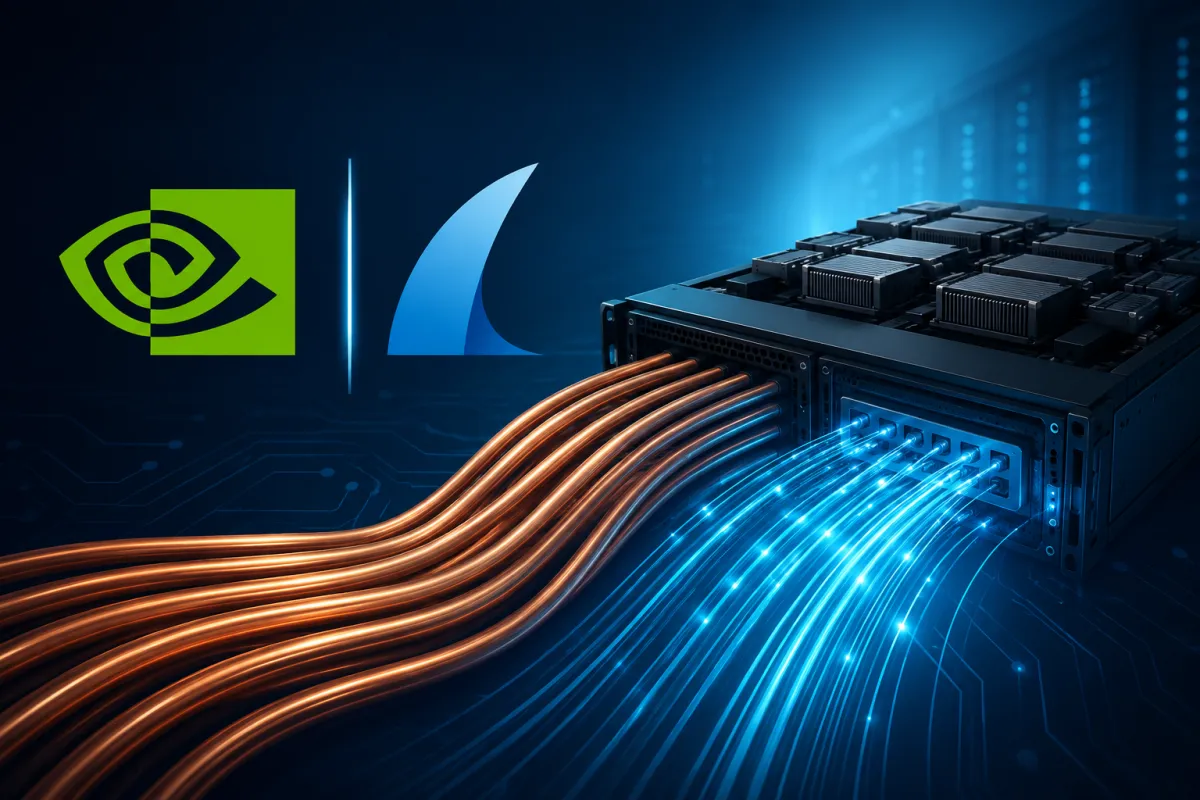
The race to build faster and more efficient AI infrastructure is entering a new phase, and two major companies are now at the center of it: Nvidia and Corning.
Corning recently announced plans to build three new factories in North Carolina and Texas dedicated entirely to products for Nvidia. While the companies have not revealed the full financial details, industry analysts believe the agreement could be worth tens of billions of dollars.
More importantly, this partnership could mark the beginning of a major shift in how AI data centers are built.
Why This Nvidia and Corning Deal Matters

Modern AI systems require enormous amounts of computing power. Inside advanced AI servers, thousands of GPUs must communicate with each other almost instantly to process massive workloads.
Until now, most of that communication has relied heavily on copper cables.
However, Nvidia appears to be moving toward a technology called co-packaged optics, which uses fiber optic glass connections instead of traditional copper wiring. Corning is expected to play a critical role in supplying the specialized glass fiber needed for this transition.
In large-scale AI systems like Nvidia’s Vera Rubin architecture, there can be nearly two miles of copper cables inside a single rack-scale system. Replacing those cables with fiber optics could dramatically improve both speed and energy efficiency.
What Is Co-Packaged Optics?
Co-packaged optics is an advanced networking technology designed to move data using light instead of electricity.
Traditional copper cables transmit electrical signals through electrons. Fiber optic cables, on the other hand, transmit data using pulses of light, or photons, through extremely thin strands of glass.
This approach offers several advantages:
- Faster data transmission
- Lower latency
- Reduced heat generation
- Significantly lower power consumption
Experts say moving photons can use between five and twenty times less power than moving electrons through copper cables.
As AI data centers continue to grow in size, power efficiency is becoming one of the industry’s biggest challenges. That is why many technology companies are now investing heavily in optical networking solutions.
AI Data Centers Need More Efficient Networking
The growth of artificial intelligence is creating unprecedented demand for computing infrastructure.
Training large AI models requires hundreds of thousands of GPUs working together simultaneously. The more GPUs connected inside a data center, the more difficult it becomes to maintain fast communication while keeping energy costs under control.
Copper works well over short distances, but as AI systems become larger and more complex, fiber optics become increasingly practical and cost-effective.
According to industry engineers, current servers already contain around two and a half miles of copper wiring. As AI clusters expand from dozens of GPUs to hundreds, the limitations of copper become more obvious.
Fiber optics solve many of these problems by delivering higher bandwidth with lower power requirements.
Corning’s Long History of Reinvention
Founded during the Gold Rush era, Corning has spent more than 175 years adapting to major technological shifts.
The company has played a role in several groundbreaking innovations, including:
- Glass for Thomas Edison’s light bulbs
- Pyrex cookware
- Television display glass
- Glass used in smartphone screens
- Medical vials for vaccines
- Fiber optic communication systems
Today, optical communications has become one of Corning’s fastest-growing businesses.
The company already supplies millions of miles of fiber optic cable to major technology firms including Meta, Microsoft, Google, Amazon Web Services, and OpenAI.
Corning has also developed newer, denser, and thinner fiber technologies optimized specifically for AI workloads.
The Future of AI Infrastructure
The partnership between Nvidia and Corning highlights a larger trend happening across the tech industry.
As artificial intelligence systems become more powerful, the infrastructure supporting them must also evolve. Faster GPUs alone are no longer enough. Networking speed, energy efficiency, and thermal management are becoming equally important.
Replacing copper with glass inside AI servers could become one of the most important technological transitions in modern data centers.
If co-packaged optics succeeds at scale, it may fundamentally reshape how future AI systems are designed — making them faster, more energy efficient, and capable of handling even larger AI workloads.
For Nvidia, this could strengthen its dominance in AI computing. For Corning, it could open the door to one of the biggest growth opportunities in the company’s history.